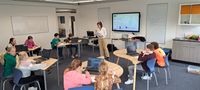
As part of the CoTEDI project, we offer training sessions for teachers to introduce the concept of computational thinking and explore how it can be developed in the classroom. During these sessions, we present practical strategies and activities that can be used with students, as well as tools and guidelines for assessing the development of computational thinking. The goal is to empower educators to confidently implement and adapt these activities in their own teaching contexts.
🇳🇱 Dutch Content
by
Dr. Nardie Fanchamps (retired)
Highly visual ICT learning environments offer excellent opportunities to enable meaningful learning about science, technology, engineering and mathematics (STEM). Application of such environments can enable tangible experience, lower the level of abstraction and increase imagination, allowing fundamental concepts underlying STEM to be taught in an understandable, meaningful way at an early age. Through inquiry-based learning, stimulation of curiosity, manipulation of concrete materials and through the encouragement of meaningful learning, such ICT learning environments can ensure that elementary school students develop a positive learning attitude and become more motivated for STEM.
Read more
🇳🇱 Dutch Content
by
Dr. Nardie Fanchamps (retired)
In the context of using technology in a different way to develop computational thinking (CT), the CoTEDI project links up with Dr Nardie Fanchamps' research on the application of music producing with electronic software. This is to identify what impact creativity can have on developing CT, and what role can be attributed to different modalities. A scientific journal article is already published.
Read more
🇪🇸 Spanish Content
by
Prof. Estefanía Martín Barroso
This activity consisted of explaining the concept of nodes and graphs to primary school children. After the explanation, they worked on it through electric cards in working groups.
Read more