
Digital Forest Explorers
A curriculum for 3rd and 4th grade in which students, as explorers of a digital forest, learn sequencing, loops, conditionals, debugging and other computational thinking concepts. It starts with unplugged activities using everyday materials, moves on to guiding and observing an mBot2 robot, and ends with block-based programming.
Digital Forest Explorers
Associação TreeTree2
Exploradores da Floresta Digital is a curriculum of 31 activities for 3rd and 4th grade in which students, as explorers of a digital forest, learn sequencing, loops, conditionals, debugging and other computational thinking concepts. It starts without technology and ends with block-based programming of an mBot2 robot. The materials are in Portuguese.
Introduction
The programme is organised in three tracks, with an increasing degree of abstraction and use of technology. The first track uses only everyday materials to introduce computational thinking concepts and some rules of digital safety. The second track brings in the mBot2 robot: students guide and observe it, running programs prepared for the project, and revisit the concepts they have already practised. The third track introduces block-based programming in mBlock, with one new concept and one new block in each activity.
No prior programming experience is needed, either from the students or from the teacher. A glossary explains each concept twice: a technical version for the teacher and a simple one, with everyday analogies, to read to the students.
Activity design
Each activity is planned for a 50-minute session and follows the same structure:
- Short procedure: the goal, the materials and the main steps of the session.
- Detailed procedure: step-by-step instructions and a script for the teacher.
- Computational thinking: an explanation of the concepts at work in the activity.
- Common problems: difficulties that may arise, with suggestions to solve them.
The unplugged activities include sheets to print, such as maps, cards and puzzles.
Track 1: Unplugged activities (15 activities)
- Map of the Lost Leaves: students make a map of leaves on the floor and plan the right sequence to collect them all.
- Following the Wolf's Trail: following a series of instructions to reach a specific place.
- The Mystery of the Footprints: finding and correcting the wrong steps in a path.
- The Ants' Secret Route: using loops to create efficient routes.
- Building the Bridge over the River: repeating instructions to build a bridge, layer by layer.
- The Treasure Hunt in the Dangerous Swamp: dividing the clues among groups that work at the same time, then putting the answers together to find the treasure.
- The Leopard's Hidden Trails: repeating simple patterns in a loop to complete trails.
- Solving the Riddle of the Stones: following conditions to move on to the next step.
- Exploring the Curved Trails: following and drawing curved trails using repeating patterns.
- The Secret Code of the Trees: putting together clues that form a secret code.
- The Maze of Shadows: solving a maze with the shadows of objects in the classroom.
- The Riddle of the Overlapping Leaves: working out the order in which the leaves fell.
- The Hidden Trails Challenge: comparing paths on a map and choosing the best one.
- Protecting the Digital Forest: discussing online risks and creating safety rules.
- Grouping the Seeds: creating classification rules from descriptions of seeds.
Track 2: Activities with the mBot2 (guide and 8 activities)
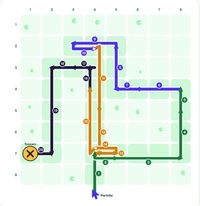
A guide to the mBot2 robot explains how to carry out recurring tasks, such as turning it on, choosing a program and returning to the home screen. In the activities, students guide the robot through a maze, collect digital leaves, avoid obstacles, move in patterns, control its speed, use its sensors to send light and sound signals, cross a digital river and, in the final challenge, work as a team to combine loops, conditionals and sensors.
Track 3: Introduction to programming (8 activities)
- First Steps: moving forward for a set time and stopping.
- Learning to Turn: moving forward and turning left or right.
- The Winding Path: combining moves and turns to follow a path with bends.
- I've Been Here Before: using loops to repeat movements.
- Going Round the Forest Trees: chaining two loops to go round two trees.
- The Dangerous Trail: detecting and avoiding obstacles.
- Following the Coloured Clues: using the colour sensor to follow a line on the floor.
- The Heart of the Forest: combining all the blocks and concepts in a final challenge.
Conclusion
Digital Forest Explorers gives primary school teachers a complete path from unplugged activities to block-based programming, with a detailed script for every session, so that teachers without a background in computing can bring computational thinking into their classrooms.
Funding
The programme was created by Associação TreeTree2 in the project Exploradores da Floresta Digital (BIP/ZIP Lisbon 2023 programme). Its online version on cotedi.pt was prepared within the Erasmus+ CoTEDI project, which is funded by the European Union under Key Action 2023-1-NL01-KA220-SCH-000152037 – OID E10207981.